Preventing AI from wiping out humanity.
We study what drives AI behavior so we can steer it as it grows more powerful.
Tap or click the grid to add a neuron and see how it changes the field.
// OUR RESEARCH
A kernel theory of how models compute
What makes a neuron respond? What can a layer represent? What information can survive through depth? YAT gives us a mathematical way to ask these questions.
YAT KERNEL
YAT scores an input against a learned center using both alignment and distance. At a fixed alignment, greater distance weakens the response. Along some directions, alignment can sustain a response even far from the center. The gravity well gives a visual intuition for this geometry.
- 01 / Neuron Explain the response
- The kernel separates the role of alignment from the role of distance. That gives us a mathematical reason why inputs can activate the same unit, even when they are far apart.
- 02 / Layer Describe what it can represent
- With shared positive bias and regularization, a YAT layer is a weighted sum of kernel responses. The theory gives that layer an exact function-space norm and characterizes what the kernel can approximate.
- 03 / Depth Explain what can carry forward
- Once earlier layers are fixed, they induce a kernel on the original inputs. If those layers map two inputs to the same representation, the next layer cannot distinguish them.
Research papers
From the mathematics of YAT to faster attention and kernel approximations.
-
A Universal Reproducing Kernel Hilbert Space from Polynomial Alignment and IMQ Distance
Introduces the YAT kernel and shows what changes when a model uses both alignment and distance to compare inputs.
-
SLAY: Geometry-Aware Spherical Linearized Attention with Yat-Kernel
Uses YAT geometry to build attention that scales linearly with sequence length.
-
Bernstein–Schur Kernels: Random Features by Sketched Modulation and Radial Randomization
Approximates kernel computations with compact random features so they can be used on larger datasets.
// THE PROBLEM
The same answer can hide different computations
▶ The Black Box Problem
When a model completes “the capital of Mexico is,” the answer tells us what it predicted. To understand how it got there, we need to know which features it used and which paths carried those signals to the output.
// TESTING A CIRCUIT EXPLANATION
From a mathematical explanation to a circuit test
The kernel describes what a unit responds to. To find out whether that response matters for a particular answer, we can test a candidate path. Take the Mexico prompt above and suppose a path carries information about the country.
- 01 / Trace Follow the signal
- Compare the Mexico prompt with the same prompt about Peru. Look for a path whose activity tracks the country as the rest of the sentence stays fixed.
- 02 / Intervene Swap the activation
- Run the Mexico prompt again and patch the candidate component with its activation from the Peru run. Compare how the scores for Mexico City and Lima shift.
- 03 / Validate Check what travels
- Compare with a patch on an unrelated component, then repeat across countries and phrasings. A repeatable, selective shift would support the circuit hypothesis.
What this opens up. The same experiment can test whether a shortcut drives a failure, whether a circuit survives fine-tuning, or whether a targeted edit changes the intended behavior without disturbing nearby capabilities.
// OUR APPROACH
From neuron responses to circuits
This illustration follows the same prompt through a small network. In a trained model, a trace would give us a candidate circuit. We would then intervene on its components and measure how the prediction changes.
- Locate
- Find components whose responses are relevant to the behavior.
- Trace
- Follow how their responses combine across layers.
- Test
- Perturb a component and compare the result with a baseline.
- Design
- Use those findings to build models that are easier to inspect.
// WHO WE ARE
The Founding Team.
The team brings together kernel research and experience building AI products.
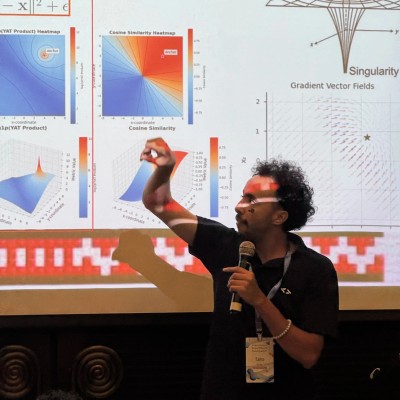
Taha Bouhsine
Co-Founder & CEO
AI Google Developer Expert and architect of the Physics Grounded AI framework. Mathematician, computer scientist, and electrical engineer researching interpretable, efficient neural networks, representation learning, and the geometry of how models understand the world. Builds rigorous, explainable AI from first principles.

Jose Miguel L.
Co-Founder & CPO
Ex-Apple Engineering Product Manager for AI/ML products. Founding team at YC-backed startup, leading Product, Data and Tech teams. Schwarzman Scholar and Columbia MBA + MS in AI/ML.
// HUGGING FACE
Models and checkpoints
Browse language and embedding models from mlnomad, or pick a checkpoint to reproduce a paper run.
Multilingual encoders
GOAT and YAT mmBERT releases for masked language modeling, text embeddings, and retrieval.
- GOAT mmBERT YAT Base Masked language modeling · 282M · FlaxMultilingual base encoder with GOAT-input attention and YATGLU layers. This checkpoint completed coverage of the prepared 10B-token corpus. Model card ↗
- YAT mmBERT Embedding v1 Text and code retrieval · 308M · FlaxEmbedding fine-tune for multilingual text retrieval and code search. The model card includes evaluation results and their limitations. Model card ↗
- YAT mmBERT Embedding v1 · PyTorch Text and code retrieval · PyTorchPyTorch conversion of the Embedding v1 checkpoint. Model card ↗
- YAT mmBERT Contrastive · 12,000 Multilingual embeddings · FlaxContrastive checkpoint used as the starting point for Embedding v1. Model card ↗
- YAT mmBERT Contrastive · 12,000 · PyTorch Multilingual embeddings · PyTorchPyTorch conversion of the step-12,000 contrastive checkpoint. Model card ↗
- YAT mmBERT Contrastive · 6,000 Multilingual embeddings · FlaxEarlier checkpoint from multilingual contrastive training. Model card ↗
- YAT mmBERT Base · MLM 48,236 Masked language modeling · FlaxYAT mmBERT base checkpoint from the masked language modeling stage. Model card ↗
Featured releases
Model cards and usage instructions.
YAT paper checkpoints
Matched 261M language models, seed 0. Each link opens the exact revision cited in the paper.
- YatNMN Softplus Per-neuron biasYAT feed-forward layers with a separate bias for each neuron and learned scaling. Paper checkpoint ↗
- YatNMN Shared Bias Shared biasYAT feed-forward layers with a shared bias and learned scaling. Paper checkpoint ↗
- GELU Baseline GELU comparisonStandard GELU feed-forward layers. Paper checkpoint ↗
Appendix G of the YAT paper links all 15 runs, with checkpoint revisions and training and evaluation records.